Research
Across these directions, I ask how quantum states emerge, evolve, move, and carry information.

Many-body electronic structure
How can many-body methods remain accurate as electronic systems grow in size and complexity?
Nonequilibrium quantum dynamics
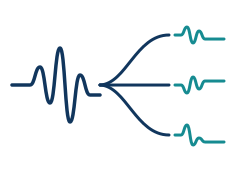
How do electronic states evolve, branch, and lose coherence far from equilibrium?

Charge, excitons, and polarons
What controls how far and how fast charge, excitons, and polarons move?

Quantum information in molecular matter
How can molecular systems encode, preserve, and control quantum information?
Selected Work
- First-principles charge transport in molecular solids solid-state DFT/DFPT electron–phonon coupling Green–Kubo dynamics arXiv (2026) SoftwarePyEPH
- Exciton dynamics, coherence, and spectra in molecular aggregates tensor-network dynamics finite-temperature response J. Phys. Chem. Lett. (2020) J. Phys. Chem. Lett. (2021) J. Phys. Chem. Lett. (2023) J. Chem. Theory Comput. (2024) SoftwareRenormalizer
- Correlated trial states for auxiliary-field quantum Monte Carlo strong correlation AFQMC tensor-network trial states J. Chem. Phys. (2024) Phys. Rev. Research (2025) Softwareipie
- Quantum and learning approaches to chemical Hilbert space quantum computing many-body learning Chem. Rev. (2025)
Publications
2026
- Delocalized coupled-cluster theory for polaron structure and dynamics.
H. Wu, M. Baumgarten, T. Jiang, J. Lee
arXiv:2608.04979 - First-principles origins of charge transport in molecular semiconductors.
T. Jiang, J. Lee
arXiv:2607.25089 - A scalable translationally invariant variational theory of ab initio polarons.
M. Baumgarten, H. Wu, T. Jiang, J. Lee
arXiv:2605.05675 - Ab initio auxiliary-field quantum Monte Carlo in the thermodynamic limit.
J. Zhang, M.F. Chen, A. Rettig, T. Jiang, P.J. Robinson, H.Q. Dinh, A.Z. Ni, J. Lee
Phys. Rev. X 16, 031044 (2026) - Resolving the body-order paradox of machine learning interatomic potentials.
S. Chong, T. Jiang, M. Domina, F. Bigi, F. Grasselli, J. Lee, M. Ceriotti
J. Chem. Phys. 164, 064121 (2026) - A benchmark of expert-level academic questions to assess AI capabilities.
Center for AI Safety, Scale AI & HLE Contributors Consortium
Nature 649, 1139 (2026)
2025
- A molecular descriptor guided asymmetric strategy for high carrier-mobility light-emitting organic semiconductors.
J. Liu, Q. Sun, Y. Shi, T. Jiang, X. Shi, J. Liu, J. Zhang, Y. Zhai, Y. Wang, Q. Peng, W. Hu, Y. Liu, Z. Shuai, L. Jiang
Aggregate 6, e70224 (2025) - Walking through Hilbert space with quantum computers.
T. Jiang, J. Zhang, M. Baumgarten, M.-F. Chen, H.Q. Dinh, A. Ganeshram, N. Maskara, A. Ni, J. Lee
Chem. Rev. 125, 4569 (2025) - Why sulfur is important in lincosamide antibiotics.
K.J.Y. Wu, E.V. Aleksandrova, P.J. Robinson, A.E. Benedetto, M. Yu, B.I.C. Tresco, D.N.Y. See, T. Jiang, A. Ramkissoon, C.F. Dunand, M.S. Svetlov, J. Lee, Y.S. Polikanov, A.G. Myers
Chem 11, 102480 (2025) - Excited state structure and decay rates for aggregates.
Z. Shuai, Q. Sun, J. Ren, T. Jiang, W. Li
Aggregate 6, e70013 (2025) - Unbiasing fermionic auxiliary-field quantum Monte Carlo with matrix product state trial wavefunctions.
T. Jiang, B. O'Gorman, A. Mahajan, J. Lee
Phys. Rev. Research 7, 013038 (2025)
2024
- TD-DMRG study of exciton dynamics with both thermal and static disorders for Fenna-Matthews-Olson complex.
Z. Sheng, T. Jiang, W. Li, Z. Shuai
J. Chem. Theory Comput. 20, 6470 (2024) - Improved modularity and new features in ipie: Toward even larger AFQMC calculations on CPUs and GPUs at zero and finite temperatures.
T. Jiang, M. Baumgarten, P.-F. Loos, A. Mahajan, A. Scemama, S.F. Ung, J. Zhang, F.D. Malone, J. Lee
J. Chem. Phys. 161, 162502 (2024)
2023
- Automatic screen-out of Ir(III) complex emitters by combined machine learning and computational analysis.
Z. Cheng, J. Liu, T. Jiang, M. Chen, F. Dai, Z. Gao, G. Ke, Z. Zhao, Q. Ou
Adv. Opt. Mater. 11, 2301093 (2023) - Unified definition of exciton coherence length for exciton-phonon coupled molecular aggregates.
T. Jiang, J. Ren, Z. Shuai
J. Phys. Chem. Lett. 14, 4541 (2023) - Influence of intermolecular packing on light emitting efficiency and carrier‑mobility of organic semiconductors: Theoretical descriptor for molecular design.
Q. Sun, T. Jiang, Q. Ou, Q. Peng, Z. Shuai
Adv. Opt. Mater. 11, 2202621 (2023)
2022
- Time-dependent density matrix renormalization group method for quantum dynamics in complex systems.
J. Ren, W. Li, T. Jiang, Y. Wang, Z. Shuai
WIREs Comput. Mol. Sci. 12, e1614 (2022)
2021
- Intermolecular charge-transfer-induced strong optical emission from herringbone H‑aggregates.
Q. Sun, J. Ren, T. Jiang, Q. Peng, Q. Ou, Z. Shuai
Nano Lett. 21, 5394 (2021) - Time-dependent density matrix renormalization group coupled with n-mode representation potentials for the excited state radiationless decay rate: Formalism and application to azulene.
J. Ren, Y. Wang, W. Li, T. Jiang, Z. Shuai
Chin. J. Chem. Phys. 34, 565 (2021) - Chebyshev matrix product states with canonical orthogonalization for spectral functions of many-body systems.
T. Jiang, J. Ren, Z. Shuai
J. Phys. Chem. Lett. 12, 9344 (2021)
2020
- Frequency domain density matrix renormalization group.
T. Jiang, J. Ren, Z. Shuai
Chem. J. Chin. Univ. 41, 2610 (2020) - A general automatic method for optimal construction of matrix product operators using bipartite graph theory.
J. Ren, W. Li, T. Jiang, Z. Shuai
J. Chem. Phys. 153, 084118 (2020) - Finite temperature dynamical density matrix renormalization group for spectroscopy in frequency domain.
T. Jiang, W. Li, J. Ren, Z. Shuai
J. Phys. Chem. Lett. 11, 3761 (2020)