Quantum Dynamics in Optoelectronic Materials
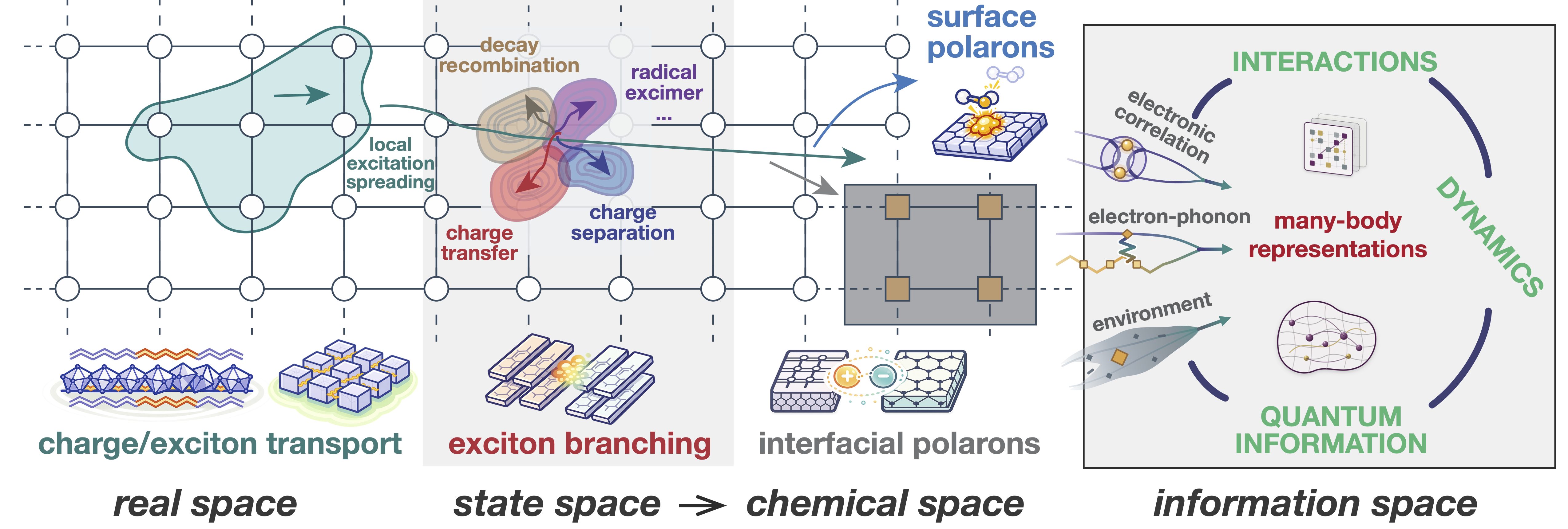
Ever since beginning my Ph.D. training, I have been interested in how energy and charge move through molecules and materials that are themselves constantly evolving. Vibrations and the surrounding environment shape how electrons behave, and an excitation in turn changes the forces on nearby atoms. This feedback decides how well an organic or perovskite solar cell separates charge, how efficiently a light-emitting diode turns current into light, how a light-harvesting complex delivers energy, and whether charge transfer at a photocatalyst surface drives a reaction.
These coupled processes make the problem both difficult and fascinating. As the figure above sketches, one can follow an excitation through real space as it travels, through state space as it branches among competing pathways, through chemical space as it rearranges bonds at an interface, and into information space, where the question becomes how to represent the underlying interactions and dynamics. Chemistry offers remarkable freedom to tune every step, and the promise for energy and optoelectronic technologies is great, which keeps me curious about why one pathway wins over another. Sitting between chemistry, physics, materials science, and computation, the field also offers many entry points, from an unexpected spectrum to a new algorithm.
During my Ph.D., I developed tensor-network methods for the spectroscopy and dynamics of electrons coupled to molecular vibrations, and applied them to exciton dynamics in the Fenna–Matthews–Olson light-harvesting complex. With collaborators, I connected the collective character of an excitation to its light emission, and studied how intermolecular charge transfer and packing control emission efficiency, nonradiative decay and carrier mobility in organic emitters and semiconductors. During my postdoc, I developed PyEPH, a first-principles framework that predicts charge transport in molecular semiconductors from atomic structure and electron–vibration coupling, and tested it against transport and optical measurements.
Going forward, I am interested in organic photovoltaic blends, layered perovskites, and oxide photocatalysts, where the questions become sharper: when does spreading an excitation help it travel, and when does atomic motion trap a charge in a way that starts chemistry rather than blocks it? Answering them means sampling many configurations at first-principles accuracy, which machine learning can make affordable.
- Jiang et al., J. Phys. Chem. Lett. 2020, 11, 3761–3768.
- Jiang et al., J. Phys. Chem. Lett. 2021, 12, 9344–9352.
- Jiang et al., J. Phys. Chem. Lett. 2023, 14, 4541–4547.
- Jiang and Lee, arXiv:2607.25089 (2026), Under Review.
- Sun, Jiang, et al., Adv. Opt. Mater. 2023, 11, 2202621.
- Sheng, Jiang, et al., J. Chem. Theory Comput. 2024, 20, 6470–6484.
- Ren, Li, Jiang, et al., J. Chem. Phys. 2020, 153, 084118.
- Sun, Ren, Jiang, et al., Nano Lett. 2021, 21, 5394–5400.
- Ren, Li, Jiang, et al., WIREs Comput. Mol. Sci. 2022, 12, e1614.
- Baumgarten, Wu, Jiang, et al., arXiv:2605.05675 (2026).
- Wu, Baumgarten, Jiang, et al., arXiv:2608.04979 (2026).
Electronic Structure of Open-Shell Systems

During my postdoc training, I was drawn to strongly interacting systems—molecules with unpaired electrons, transition-metal complexes such as iron–sulfur clusters, and assemblies of organic radicals—because they turn familiar chemical choices like composition, geometry, and packing into control over bonding and magnetism. The stakes are practical: electronic rearrangements at metal centers let enzymes and catalysts bind small molecules and activate bonds, while unpaired spins in radicals and metal complexes are building blocks for molecular magnets and quantum technologies. When two radicals approach, for example, their spins may stay on separate molecules and couple magnetically, or the electrons may pair into a new bond. Telling these apart requires accurate energies of competing states.
A full description of interacting electrons quickly becomes too large to handle, so the methods matter. I combined matrix product states with auxiliary-field quantum Monte Carlo (AFQMC) to reduce its systematic errors for strongly interacting electrons. I also developed new features in ipie, an open-source AFQMC code, enabling larger calculations on CPUs and GPUs. AFQMC has had real successes, but new challenges keep emerging as it is pushed toward larger and more strongly correlated systems. I am broadly exploring how to improve it further, drawing inspiration from tensor and neural networks, and quantum algorithms.
- Jiang et al., J. Chem. Phys. 2024, 161, 162502.
- Jiang et al., Phys. Rev. Research 2025, 7, 013038.
- Zhang, …, Jiang, et al., Phys. Rev. X 2026, 16, 031044.
- Wu, …, Jiang, et al., Chem 2025, 11, 102480.
More work is underway.
Machine Learning and Agentic AI
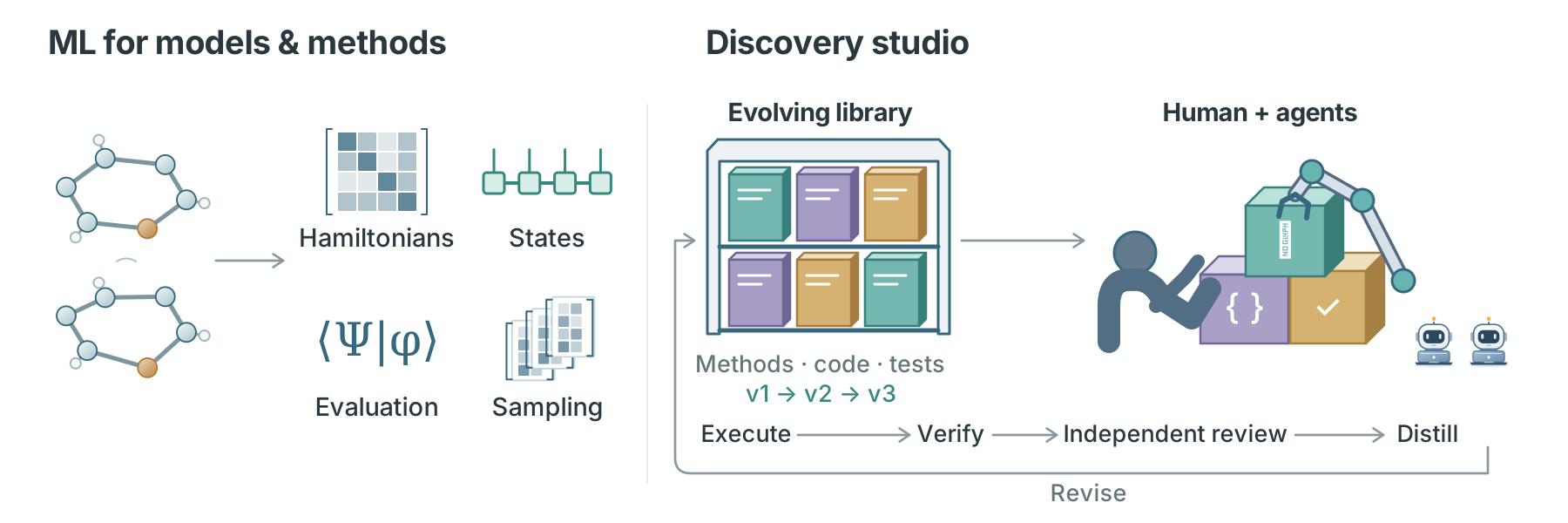
Machine learning can strengthen both topics above. State-of-the-art models such as equivariant networks and atomistic foundation models can make first-principles energies reusable across structures, compress correlated wavefunctions, and cut the cost of sampling. The hard part is keeping the physics: knowing what a model must represent exactly, and whether it holds beyond its training data. With collaborators, I have studied how machine-learned interatomic potentials represent many-body interactions and used machine learning to screen iridium-complex emitters for light-emitting devices. I am now developing geometry-aware learning of compact correlated states for quantum Monte Carlo that transfer across geometries.
Beyond improving established methods, I am interested in agentic AI for open-ended research. Generative AI has lowered the barriers to implementing algorithms, and agents can now run many cycles of derivation, implementation, and validation in parallel, yet successful execution does not ensure sound research decisions. How should researchers and agents share the work of discovery, and which judgments should remain human? Nobody yet knows the best practice, so I explore it in my own research: using agents to go beyond established many-body algorithms with the field’s condensed knowledge and careful benchmarks, and to trace observables back to mechanisms by proposing the measurement that separates competing models. My preliminary AgentFarm organizes this around execution, verification, independent review, and knowledge distillation, and I expect it to keep evolving with the community’s.
- AgentFarm on GitHub; essay: A lobby for unfinished experiments.
- Chong, Jiang, et al., J. Chem. Phys. 2026, 164, 064121.
- Cheng, Liu, Jiang, et al., Adv. Opt. Mater. 2023, 11, 2301093.
Quantum Algorithms for Chemistry
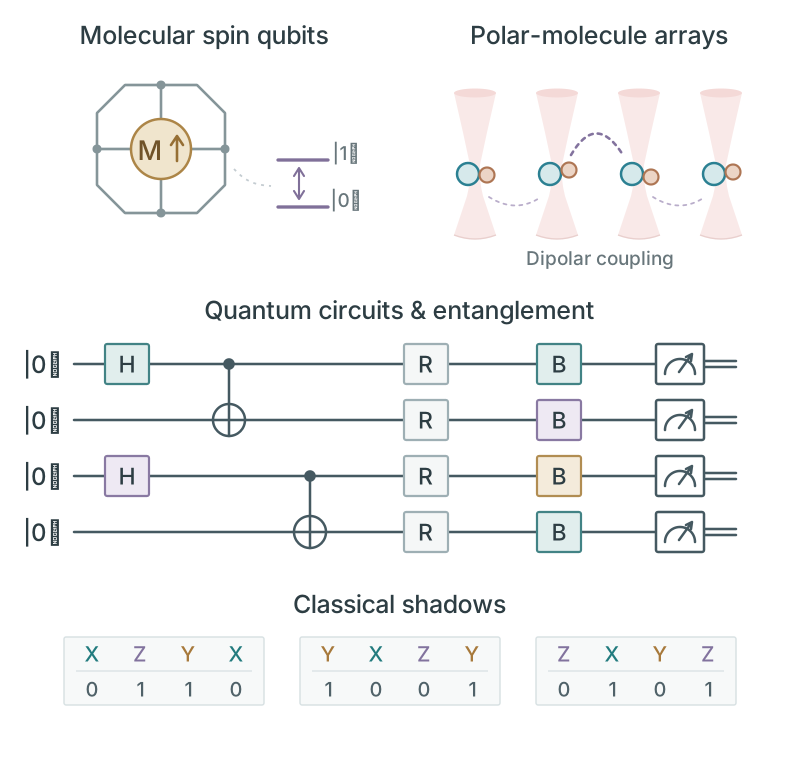
I am also interested in how quantum computers might help with the hardest parts of these problems. Interacting electrons, thermal nuclear motions, and computing observables all come down to sampling an enormous space of quantum states, which is where quantum hardware could eventually outperform classical machines. Whether such an advantage exists, and how it would fit inside a practical chemical calculation, remain open questions. My bet is that the search pays off either way: ideas from quantum algorithms can sharpen classical many-body methods, classical theory can guide where and how quantum hardware is best used, and each exchange teaches us something new about the problems themselves.
With collaborators, I reviewed quantum algorithms from a sampling perspective, from hybrid quantum–classical to fully quantum approaches, side by side with their classical counterparts. The AFQMC algorithms we developed serve both classical and quantum-assisted calculations and have since been adopted by other academic and industry groups. In work in preparation with Google Quantum AI, we combine advanced classical-shadow and sampling algorithms to extend quantum-assisted AFQMC to strongly correlated molecules previously beyond its reach. Going forward, I want to find where quantum resources pay off in related algorithms and applications, and to measure each gain against the best classical alternative.
- Jiang et al., Phys. Rev. Research 2025, 7, 013038.
- Jiang et al., Chem. Rev. 2025, 125, 4569–4602.
More work is underway.